

There is a question that starts circulating around LightHouse sometime in the late morning: what's for lunch? It's one of the most important questions of the day.
Lunch is cooked from scratch every day in our commerical kitchen, and depending on the day, the answer might be tortilla-crusted tilapia, coconut curry soup, or chicken and sausage gumbo. By noon, most of us are in the Dining Room eating it together.
Most of the people getting it onto the table are students.
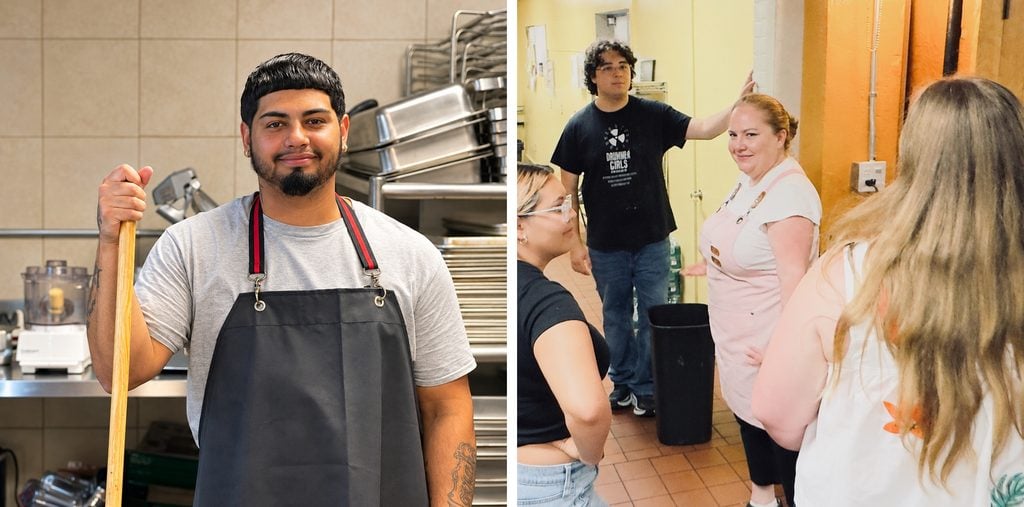
Our kitchen is both the place where we make lunch and a working culinary classroom. Students on Lunch Team learn their way around a commercial kitchen, from knife skills and food safety to prep, cooking, sanitation, timing, and working together when eighty hungry people are about to walk through the door. They earn ServSafe certification, and some are already taking what they've learned into paid shifts at events and catering jobs in our own De la Luz venues.
Leading all of this is Sara Barnes, our Director of Culinary & Hospitality, alongside Ricky Montalvo, our Second Chef. Ricky started out washing dishes for us and quickly worked his way into the kitchen, where he is now Sara's teammate in feeding the whole school every day.
Together, Sara and Ricky work with a rotating crew of young people to make lunch happen.
Then everyone shows up to eat what they made.
Sara's route to the LightHouse kitchen was not exactly direct. She originally came to us through De la Luz, where she is our venue chef. If you've eaten at a De la Luz show, you've almost certainly eaten something Sara made. She creates different menus for different events, often playing with the music, the artist, or the culture surrounding a performance.
Last year, when our school chef, Blue, went on paternity leave, Sara stepped in. Blue later decided to stay home with his baby (great call, Blue), so Sara stayed. She is now our daytime and evening chef. She's also teaching biology! More on that in a bit.
I grew up in a large family and I am the oldest of five children. I come from a family that values food and cooking and we would all pitch in to help celebrate holidays, birthdays, or just any special occasion. As a small child I remember standing on a stepstool in my grandmother's kitchen, watching her fry chicken, listening to the sound of chicken skin crackling in the oil, and using the drippings and crispy bits to make a southern style gravy. By the time I was 10 years old I was regularly helping my dad cook dinner for our family using vegetables from our garden or frying up bluegills that we caught on the lake. My dad also apprenticed as a butcher when he was young and so we often butchered our own meats. Initially, I began working in restaurants to help me pay for college, but I was drawn to the different styles of cuisine that I saw different chefs cooking.
I never thought I would become a chef, I always thought that I would be a scientist or a doctor. I went to school to study biochemistry but soon realized that I missed the chaos and camaraderie of the service industry. While I was working in science labs and waiting on experiments to run their course I would often find myself daydreaming about upcoming family gatherings and what fancy things we should cook for our next birthday party or Christmas dinner. When my sister got married she asked me if I could make her wedding cake and help coordinate the event. Several of the guests at her wedding then followed with their own catering requests and I realized that I might be able to turn my hobby into a business.
Cooking for teenagers is its own particular culinary challenge. They have opinions. One of the things we care deeply about at LightHouse is giving young people access to good food: fresh, made here, with a wide range of ingredients, flavors, and cuisines.
Not everyone likes everything. They definitely don't. But every day brings another chance to encounter something new. Because we all eat the same meal together, students see other people eating it, talking about it, going back for seconds, or trying something they might otherwise have passed over. Over time, tastes can change.
I really like to make food approachable and offer multiple different options. I want the kids to try different things and we try to encourage them, even if they don't think they will like it! We do our best to provide a salad bar and fresh fruit every day. On days that we are preparing something a little less approachable (a dish with multiple ingredients like a curry, or gumbo) I like to have some options that are also plain and simple, that I know they will like: roasted potatoes, beans and rice, or garlic bread. No pressure!
Yes, absolutely! Some days we have menus that I know the kids will love, Pizza Bagels, for example. We use day-old bagels from Comfort Bagel but make our own tomato sauce and toppings in house. But some days I like to mix it up and offer a new kind of cuisine, from a different culture. Chicken Tikka Masala, Fried Rice with Dumplings, Posole. I was shocked at how much they loved the Posole, a Mexican soup made with hominy and chipotle peppers.
The kids were definitely reluctant to try the fish, a tortilla-crusted tilapia that I thought was delicious. We accommodate all different diets, vegetarian, vegan, gluten-free, etc. I have been surprised at how many kids will ask to try the tofu dish or the gluten free dish. I feel like now that they know the food is going to be well prepared and tasty they are more curious about trying what we make.
Lunch Team students come in with very different levels of experience. Some are already comfortable in a kitchen. Some aren't. They learn by doing the actual work of feeding the school: knife skills, food preparation, commercial equipment, sanitation, timing, teamwork, and eventually taking responsibility for pieces of a meal.
They also earn ServSafe certification. For students interested in culinary or hospitality work, these aren't pretend workplace skills. They're learning in a working commercial kitchen, and some are already moving from Lunch Team into paid catering and event shifts at De la Luz, our onsite performing arts venue.
For students who never intend to work in a kitchen, knowing how to handle food safely, turn fresh ingredients into a meal, and feed yourself and other people are pretty useful skills to carry into adulthood.
Safety. On the first day of class we go over the kitchen rules. And we continue to reinforce these rules throughout the semester. If kids aren't paying attention they could actually get hurt. I don’t just go through a list of rules, we also talk about WHY these rules are in place. For example, no headphones. You have to be able to hear if someone is walking behind you and coming through with a big pot of hot water. You have to be aware of your surroundings and move out of the way so you don’t get burned.
Keep it clean! Whatever you are cooking, you want your space to be clean and the ingredients to be as fresh as possible. I just want them to be safe!
Lunch has one feature that sets it apart from most school assignments: it has to come out on time. There is no extension until Monday. If something goes wrong at 11:40, eighty-ish hungry people are still going to appear at noon, and those people are your friends, your teachers, and the people you spend every day with.
We pivot. You have to be flexible and be able to change the plan. I try very hard to stay ahead of the game but sometimes disasters happen. I usually have a backup plan, some homemade soups in the freezer, some bread we can pull out and turn into a grilled cheese sandwich or garlic bread, some chicken we can grill off quickly for grilled chicken salads. The last 20 minutes of lunch prep are always all hands on deck!
Yes, absolutely! I have found that the majority of students who sign up for Lunch Team become awesome team players once they know what is expected of them. The kitchen is a great space for students who have trouble sitting still for lecture-based coursework. I also think that they are able to take pride in their work because they see the immediate impacts of their labor. I think that working in the kitchen gives them a tangible and immediate opportunity for feedback, for example, if a student completes a specific dish, the garlic bread or the guacamole, and other students enjoy it, they see immediately that their contribution is necessary and valuable. Some of our current Lunch Team students are now helping me with paid events and catering and they are very knowledgeable and professional.
Then there is the slightly improbable fact that the person making lunch is also teaching biology. Sara has a background in science, and this year she brought that part of herself to LightHouse too. The combination makes more sense than it may sound.
Yes to both questions. I think of myself as a scientist first and foremost, but I suppose that I am just interested in learning more about how things work. I ran a lab for many years before I embarked on my current culinary journey and the two jobs are remarkably similar. There is equipment that needs to function and be repaired, there are creative and intelligent people that you need to work with, and ultimately, every time we cook something it is an experiment. We bring ingredients into the space, we apply heat, acid, and pressure; we use mathematics daily and then we see what comes out of the other end of those equations. Cooking is the ultimate fusion of physics, chemistry, biology, mathematics and art.
Life often has rhythms that become so ordinary to the people inside them that you stop noticing how special they are. Lunch is one of ours. Someone starts cooking in the morning. Students come in and out of the kitchen. Things get chopped and roasted and stirred. Someone tries something they've never eaten before. Someone learns to make something they may still be making for themselves twenty years from now. Then, at noon, the work disappears onto plates and we sit down together as a community, frequently with guests.
Lunch is one of the few times each day when nearly everyone at LightHouse stops what they're doing and gathers in the same room. Youth and adults eat the same food at the same tables. There is conversation and noise, and many come back for seconds.
I hope that students feel the humanity in the experience. We are living in an unprecedented time. Technology is moving so quickly. It is so easy to sit at home, alone, on your computer and feel like you are connecting with people when, in reality, you are so isolated. Sitting down and eating a meal together is so important for our connection. We are not machines, we are human. We may be having a good day or a bad day but I think that taking the time to share a meal together is something that connects us with each other and hopefully allows us to see each other, and just be present for each other.
And the next morning, Sara, Ricky, and Lunch Team start all over again. Thank you!